The UCA and Research Assessment
A context favorable to open science
The UCA is committed to complying with the principles promoted by CoARA and places open science at the heart of its research assessment reform. This approach aims to facilitate an effective transition toward more qualitative assessment practices.This change is reflected in the implementation of updated policies designed to better account for the diversity of researchers’ activities and contributions. It is in line with national and European guidelines, with the aim of promoting a more qualitative and responsible assessment that is tailored to the contemporary challenges facing research.
- Discover the timeline
-
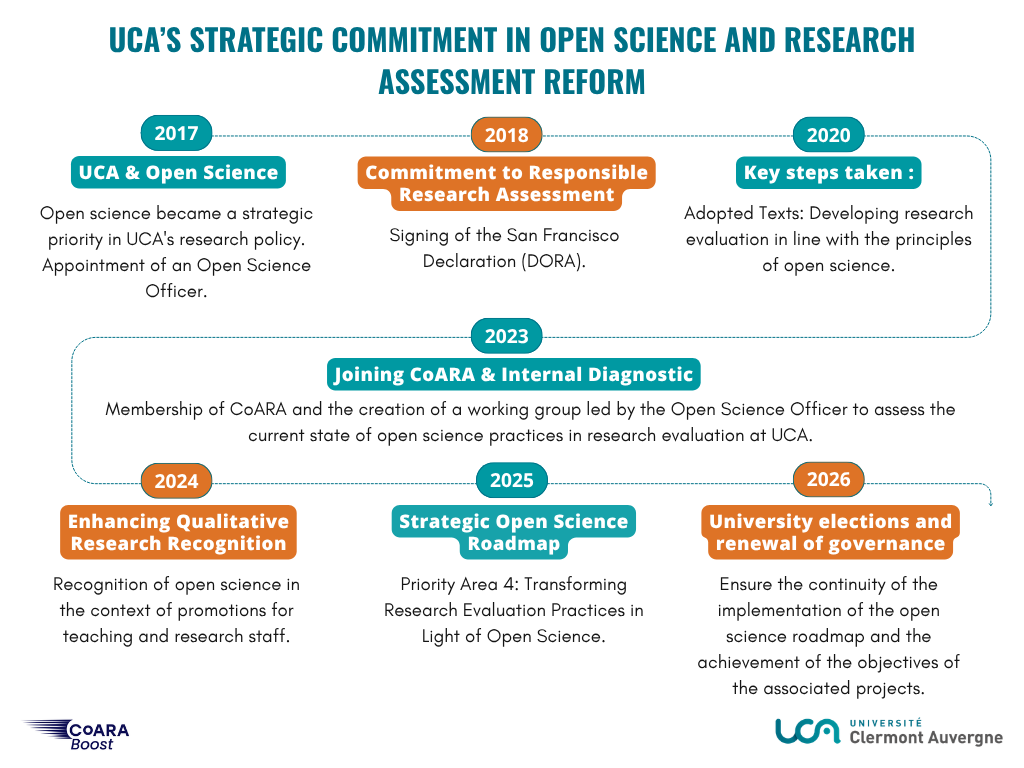
2017
This journey began in 2017, when open science was officially established as a strategic priority within the university’s research policy, alongside the appointment of an Open Science Project Manager and the creation of the Open Science Unit, a dedicated support unit. This unit aims to support UCA researchers in adopting open science as the standard practice. It provides support for research data management (management plans, format selection, repositories, and licenses), conducts awareness-raising and training initiatives (workshops, webinars, and dedicated events), and ensures close coordination with the University Library and relevant national bodies. It also contributes to the promotion of scientific integrity, particularly with regard to publication transparency and the management of sensitive data.2018
The UCA has reinforced its commitment by signing the San Francisco Declaration on Research Assessment (DORA), thereby endorsing responsible assessment practices and reducing reliance on bibliometric indicators.
DORA is an international initiative launched in 2012 to improve the assessment of research. It criticises the over-reliance on the impact factor and promotes more balanced practices, based on recognition of the diversity of scientific contributions and greater transparency and the responsible use of bibliometric indicators.2020
Institutional measures were implemented through the adoption of internal policies designed to guide the development of research assessment frameworks. These measures aim to better recognise the diversity of research outputs and practices, in line with the recommendations of the Academic Council.2023
UCA’s commitment was further strengthened in 2023 with its membership of the Coalition for Advancing Research Assessment (CoARA), accompanied by the creation of a dedicated working group (WG), led by the Open Science Project Manager and supported by UCA’s Vice-President for Research. As part of this WG’s work, an assessment was carried out which identified several persistent challenges in the field of open science, notably an over-reliance on bibliometric indicators, an uneven understanding and adoption of qualitative evaluation approaches within the academic community, the lack of common frameworks and tools, and the need for targeted training for evaluators.2024
Following this assessment, targeted measures were implemented to better recognise and reward contributions that align with the principles of open science within academic career paths, particularly under the new Remuneration Scheme for Teaching and Research Staff (RIPEC), which aims to increase salaries and harmonise bonuses across the various staff categories.2025
This strategic commitment is also reflected in the adoption of the UCA’s Open Science Roadmap, in 2025, which is structured around five key areas:
- Priority 1: Build momentum toward open access to publications
- Priority 2: Implement a scientific publishing strategy centered on the diamond model
- Priority 3: Share and make research data, source code, and software openly available
- Priority 4: Transform research assessment in light of open science
- Priority 5: Make open science the default principle
2026
To ensure consistent and efficient implementation, the Open Science Unit relies on a structured and operational governance system. Since early 2026, each priority area of the roadmap has been placed under the responsibility of a dedicated coordinator, who is tasked with monitoring actions and ensuring that the associated objectives are met. Coordination is based on regular meetings, combining monthly in-person sessions with more focused remote progress updates.
At the same time, UCA’s commitment was strengthened by the award of funding in September 2025 for the OSQuAR-UCA project as part of the CoARABoost call for proposals. As one of only two projects selected from the 2025 call in France, this initiative aims to integrate open science practices into the evaluation of qualitative research at UCA, in accordance with European standards and CoARA principles. The one-year project builds on the findings of the assessment conducted and aims to support the implementation of more qualitative evaluation frameworks within UCA.
Reforming research evaluation: a central focus of the UCA's Open Science Roadmap
In 2025, the UCA published a roadmap for the 2025–2027 period to commit to open science. Among its five priorities, reforming research evaluation is a central priority (Priority 4), aimed at embedding the principles of open science in assessment processes, in accordance with CoARA’s commitments.
Actions of priority 4:
A - Developing a CoARA Action Plan
- Establish a working group comprising members of the Research Council, the Council of Faculty and Research Faculty (CP2E), the HRS4R (Human Resources Strategy for Researchers) Steering Committee, and the Ethics and Professional Conduct Committee.
- Conduct a review of current practices for assessing research and staff
- Organize workshops, conferences, and meetings
B - Proposed Changes to Research Evaluation Practices
- Develop a guide to best practices for research assessment in the context of open science
- Provide assessors and those being assessed with a toolkit and training
- Ensure the gradual implementation of the new assessment criteria