Introduction to CoARA
The CoARA initiative
The Coalition for Advancing Research Assessment (CoARA) is a collaborative initiative launched in 2022 with the aim of reforming research assessment practices on an international scale. Its overall goal is to improve the quality and impact of research by recognizing the diversity of research outputs, practices, and activities, as well as of researchers and research organizations.
Université Clermont Auvergne signed the CoARA agreement in November 2022, marking a significant institutional commitment. By becoming a member, UCA is committed to advancing reform in research assessment, taking into account the diversity of research activities and approaches.
This agreement calls for a shift toward assessment practices based on peer review, recognition of the diversity of scientific contributions, and the responsible use of quantitative indicators.
10 key commitments
« The Agreement, based on 10 commitments, establishes a common direction for research assessment reform, while respecting organisations’ autonomy. » - CoARA
- Recognise the diversity of contributions to, and careers in, research in accordance with the needs and nature of the research
- Base research assessment primarily on qualitative evaluation for which peer review is central, supported by responsible use of quantitative indicators
- Abandon inappropriate uses in research assessment of journal- and publication-based metrics, in particular inappropriate uses of Journal Impact Factor (JIF) and h-index
- Avoid the use of rankings of research organisations in research assessment
- Commit resources to reforming research assessment as is needed to achieve the organisational changes committed to
- Review and develop research assessment criteria, tools and processes
- Raise awareness of research assessment reform and provide transparent communication, guidance, and training on assessment criteria and processes as well as their use
- Exchange practices and experiences to enable mutual learning within and beyond the Coalition
- Communicate progress made on adherence to the Principles and implementation of the Commitments
- Evaluate practices, criteria and tools based on solid evidence and the state-of-the-art in research on research, and make data openly available for evidence gathering and research
« In the context of the CoARA Agreement on Reforming Research Assessment, signatory organisations [...] are invited to share with the community how their organisation has started the process of implementing the Core Commitments according to an Action Plan with defined milestones within one year of signing the Agreement » - CoARA
An international network
On April 27, 2026, there were 832 CoARA member organizations worldwide, including more than 60 French organizations. These members include:
- Universities and their associations.
- Research centers, research infrastructures, and their associations.
- Academies, learned societies, and their associations, as well as researchers’ associations.
- Public or private research funding organizations and their associations.
- National or regional authorities or organizations that conduct some form of research assessment, and their associations.
- Other relevant nonprofit organizations involved in research assessment, and their associations.
However, only CoARA members participate in general meetings, vote for candidates for the executive committee and on other governance matters, and take part in collective decision-making within the coalition. Signatories may become members at any time; there is no membership fee.
National chapters
Within CoARA, there are national chapter, which are groups of stakeholders from the same country who have decided to collaborate in contributing to research assessment reform. These members coordinate their efforts to apply the CoARA principles at the national level. This ensures, in particular, that national rules, culture, and policies are taken into account. The participation of members is voluntary, and each national chapter produces deliverables to support the implementation of the Agreement within the national context.
In France, there is the French National Chapter of CoARA, an initiative launched in October 2023 within the Committee for Open Science, which currently brings together 41 French organizations (universities, research institutions, funding agencies, and associations). Its main goal is to create a forum for exchange and collaboration among stakeholders in research assessment, to share best practices and prevent the isolation of professionals responsible for these tasks.
The chapter thus facilitates communication among research institutions by coordinating an inventory of assessment practices, supporting the development of local action plans at each institution, and actively participating in CoARA’s international working groups to strengthen collective capacity building.
« The vision of CoARA is to recognise the diverse outputs, practices, and activities that maximise the quality and impact of research through an emphasis on qualitative judgement in assessment, for which peer review is essential, supported by the responsible use of quantitative indicators. » - CoARA
Sharing of practices and knowledge
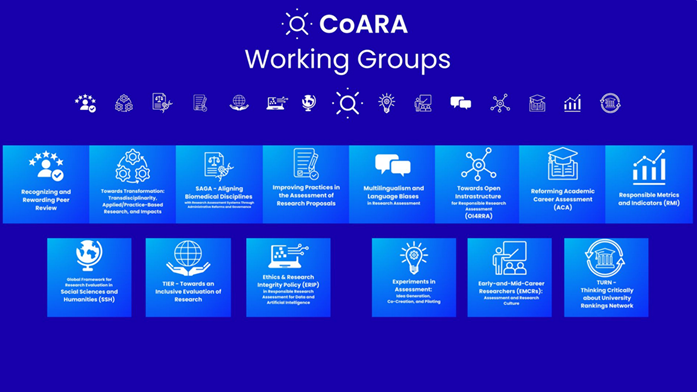
To support the reform of research assessment, working groups have been established within CoARA. As true communities of practice, they promote knowledge sharing and mutual learning among coalition members.
Operating on a voluntary basis, these groups bring together participants from European and international institutions to address specific topics. Their goal is to produce concrete recommendations, tools, and lessons learned to support their members in implementing the commitments of the Agreement on Research Assessment Reform.
Their work is based on meetings, workshops, and collaborative projects, which enable them to collectively advance key issues related to this reform.